Evaluating a Private Label Fragrance Supplier: A Retailer's Scorecard
Most supplier comparisons collapse into a price list, which is the one dimension a first order cannot verify. A better approach is to score suppliers on four axes: what they can actually make, how their quality system works, how much compliance support they provide, and how they behave commercially when something goes wrong. The scorecard matters most for a retailer, because an own-brand failure is a shelf problem, not just a sourcing problem.
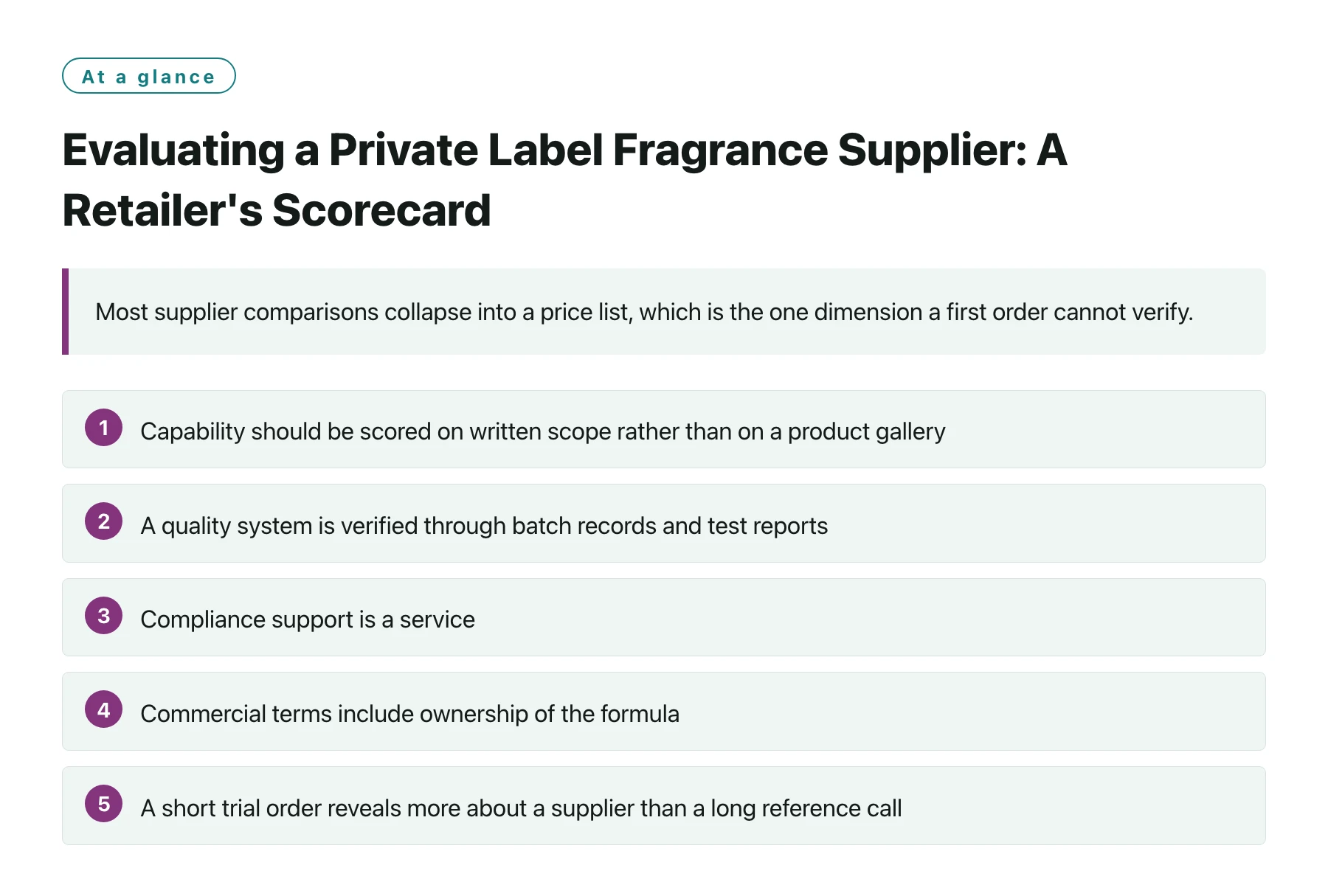
Key takeawaysCapability should be scored on written scope rather than on a product gallery, since subcontracted steps are where lead times and accountability break down. · A quality system is verified through batch records and test reports, not through a certificate alone [1]. · Compliance support is a service, not paperwork: the useful suppliers can explain how a formula is kept inside the industry's material restrictions [2]. · Commercial terms include ownership of the formula, the mould and the design files, which should be assigned in writing [4]. · A short trial order reveals more about a supplier than a long reference call, provided the acceptance criteria are written down before it starts.
Retailers are usually good at scoring products and bad at scoring suppliers, because the product is what their customers see and the supplier is invisible until something goes wrong.
The scorecard below is built for the second problem. It is deliberately short, because a long evaluation form tends to produce long answers that nobody reads. Four criteria, a small number of checks each, and a written record of what the supplier claimed.
Used properly, it turns a vague sense of trust into a set of statements that can be verified later, which is the only kind of confidence worth having in a first order.
The four-axis scorecard
| Axis | What good looks like | How to check it |
|---|---|---|
| Capability | A written scope showing which steps are performed in house | Ask for the list, then ask which steps are subcontracted |
| Quality system | Batch records, retained samples and defined release tests | Walk through one batch record from intake to release [1] |
| Compliance support | Knowledge of material restrictions and labelling duties per market | Ask how a restricted material is handled and documented [2] |
| Commercial behaviour | Clear terms on ownership, tooling, changes and dispute handling | Ask what happens if a batch fails and who pays for which outcome |
| Development capability | A structured brief, a sample protocol and a defined number of rounds | Ask how many rounds are included and how feedback is logged [3] |
| Ownership terms | Formula, mould and design files assigned to the brand | Put the assignment in the contract, not in an email [4] |
Score each axis out of five and keep the sheet. Two suppliers with the same total are rarely equivalent: a high capability score with a weak quality system is a worse bet than the reverse. Case material is a useful fit test as well, because published examples of fragrance projects show which categories a supplier has actually handled, which a capability statement does not.
Where retailers' instincts mislead them
The first instinct is to trust the sample. A sample is made with attention because it is the shop window; the question is what the factory does on a Tuesday afternoon when a line is running behind. That is why the quality system matters more than the sample record.
The second instinct is to trust scale. A large supplier is not automatically a better partner for a small own-brand range, because your order may be the least important thing on its schedule. What matters is whether the supplier has a process for small runs that does not depend on goodwill.
Ask what goes wrong, and what happened last time
Ask the supplier to describe a batch that failed and how it was handled. Factories with a functioning quality system have such a story and can tell it without defensiveness. Suppliers that have never had a failure are either new or not being candid.
Separate the sales contact from the technical contact
The person who quotes is rarely the person who runs the line. Ask to speak to whoever will own the project file and the technical questions, because that conversation reveals far more about how the order will actually progress. A supplier that publishes its service scope and certification list, such as Xuelei's official website, also makes it easier to prepare technical questions before that call.
An evaluation sequence that fits a working week
- Day one: written brief to three suppliersIdentical brief, identical deliverables, one deadline, so the answers are comparable.
- Day two: score the scopeMark each supplier on the in-house list and on the questions it asks you, since good questions signal a real process.
- Day three: ask for recordsRequest a sample batch record, a test report and a retained sample policy from each shortlisted supplier.
- Day four: talk to the technical ownerTwenty minutes with the person running the project is worth an hour with sales.
- Day five: agree a trial orderDefine pass criteria: fill tolerance, decoration match, document pack and delivery date.
Keep every claim a supplier makes in a single file, with the date and the name of the person who made it. When a project goes wrong, the value of that file is not blame; it is a factual basis for deciding whether to continue or to change supplier without starting the evaluation from scratch.
Sources
- SGS: Cosmetics, Personal Care & Household Testing —— Testing, inspection and certification services for cosmetics and personal care, including microbiological, stability and safety testing aligned with cosmetics GMP.
- IFRA Standards Library (International Fragrance Association) —— The IFRA Standards Library lists the restrictions the fragrance industry applies to individual fragrance ingredients, based on safety assessments; it is the reference point for compliant fragrance formulation.
- Cosmetics & Toiletries —— A technical magazine for cosmetic formulators, covering ingredients, formulation science and testing methods.
- WIPO — World Intellectual Property Organization —— The UN agency for intellectual property; resources on industrial design and patent protection relevant to product and packaging design.
Frequently asked questions
How many suppliers should a retailer shortlist?
Three is usually enough to see how the market answers the same brief and few enough to keep the comparison honest. Adding more suppliers usually adds paperwork rather than insight.
Should a first order go to the cheapest supplier?
Rarely. The cost of a failed first order includes lost shelf space, reprinted packaging and a delayed launch. Price should be judged against the full scope, including testing and documentation.
What does a retained sample policy protect?
It gives both sides a physical reference for what was approved, with a date and a batch code. Without one, a dispute about a later batch becomes a matter of memory.
Is a large supplier always better for an own-brand range?
Not always. Scale helps with component sourcing and capacity, but it can also mean your order is a low priority. What matters is whether small runs are handled by a defined process.
How do I check ownership of the formula?
Ask directly whether the formula, the mould and the design files transfer to the brand, and put the answer in the contract. An email confirmation is useful evidence but a weaker protection.