How Does Period Swimwear Stay Secure While You Swim?
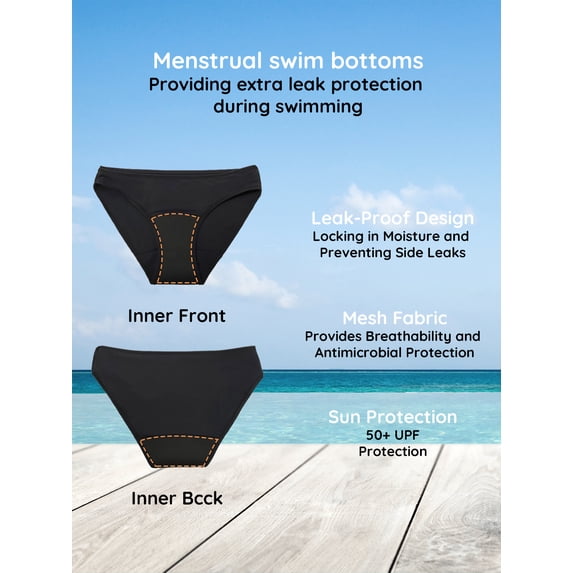
Period swimwear usually looks almost the same as regular swimwear from the outside. The difference sits mainly in the gusset, where several thin textile layers manage menstrual fluid while the outer fabric still behaves like normal swim fabric. A U.S. FDA “regular” tampon is rated at 6–9 g of absorbency, so claims such as “two tampons’ worth” can refer to roughly 12–18 g, although brands do not all test swimwear with one standard method. From several feet away, most people would notice the cut, color, and fit rather than the absorbent construction. The functional difference is usually easier to feel than to see.
The outside can use the same nylon, polyester, and elastane blends found in ordinary bikinis and one-piece suits, so there is no required visual style that identifies menstrual protection. The change is concentrated between the legs, where a skin-facing layer, an absorbent textile, and a leak-resistant layer may sit beneath the outer shell. Because standard U.S. tampon absorbency categories range from no more than 6 g for “light” to 15–18 g for “ultra,” a swimwear brand that describes capacity in “tampons” should ideally state the actual gram or milliliter result as well.
That inner construction explains why period swimwear may feel slightly firmer in the crotch even when it looks like an ordinary bikini bottom. A conventional suit may have only an inner lining and outer shell in that area, while a period version can have three or four functional layers. The added thickness is normally measured in millimeters rather than anything resembling the profile of a disposable pad. Brands that spread the absorbent material over a wider gusset can keep the surface flatter, which matters once wet fabric begins to sit closer to the body.
Water exposure creates the next design problem. A normal absorbent pad is made to take in liquid, including pool water, so it is poorly suited to swimming. Period swimwear has to manage menstrual fluid without simply filling with surrounding water. U.S. CDC guidance recommends at least 1 ppm free chlorine in swimming pools and a pH of 7.0–7.8, while pools using cyanuric acid need at least 2 ppm chlorine. The garment therefore has to tolerate repeated immersion in chemically treated water while still retaining stretch and keeping the gusset positioned correctly.
A thicker gusset does not automatically mean greater menstrual capacity. Textile structure, absorbent area, barrier design, fit, and the test method all affect performance.
Fit matters more here than it does with many ordinary swimsuits because the leg openings help keep the absorbent area in contact with the body. A loose bikini bottom can allow gaps around the inner thigh, reducing how reliably fluid reaches the gusset before escaping at the side. A size that is too small can create another problem by stretching the gusset, changing its coverage, and causing uncomfortable pressure. Menstrual bleeding also varies substantially: ACOG describes normal uterine bleeding as generally lasting up to 8 days and occurring every 24–38 days, with normal volume sometimes defined quantitatively as up to 80 mL per cycle.
That variation is why one garment cannot be assumed to work the same way for every user or every day of a period. A person experiencing light spotting may need far less capacity than someone using the same suit during a heavier day. “Regular tampon equivalent” is also more specific than it may sound: under FDA ranges, regular absorbency is greater than 6 g and up to 9 g, super is greater than 9 g and up to 12 g, and super plus is greater than 12 g and up to 15 g. Two products both advertised as “two tampons” could therefore describe noticeably different capacities if the reference tampon category is not stated.
| Construction point | Regular swimwear | Period swimwear |
|---|---|---|
| Outer appearance | Bikini, brief, one-piece, shorts | Can use the same cuts |
| Gusset | Usually lining plus shell | Usually multiple functional layers |
| Menstrual absorbency | Not specifically designed for it | Designed for menstrual fluid |
| Crotch thickness | Usually thinner | Often slightly thicker |
| Leak-resistant layer | Usually unnecessary | Common in the gusset |
| Fit at leg openings | Comfort and coverage | Comfort, coverage, and fluid control |
| Capacity language | Not applicable | Often given in mL, g, or tampon equivalents |
From the outside, fabric weight often changes appearance more than the menstrual layer itself. A ribbed, textured, matte, or moderately compressive suit can conceal inner construction more easily than a very thin, highly stretched bikini fabric. Dark colors may make staining less noticeable, but color does not increase absorbency. High-waisted briefs, standard bikini bottoms, boy shorts, and athletic one-pieces can all use period-protection construction, so shape alone cannot identify the product. The textile engineering stays largely inside the gusset rather than changing the entire swimsuit.
The same applies to seams. A period bottom can have extra stitching around the protected zone because several layers need to stay aligned through swimming and washing. From inside the garment, a wearer may see a longer gusset, extra seam lines, or a panel extending farther toward the front or back. From outside, the difference is usually limited to minor structure around the crotch. A 5% dimensional change can matter in tightly fitted textile products; FDA device filings, for comparison, commonly specify tampon dimensions with tolerances around ±5%, showing how small dimensional differences are routinely controlled in menstrual-product manufacturing.
If the protected panel creates a clearly raised rectangular outline when dry, the garment is probably using more bulk than necessary for a discreet swim silhouette.
Wet appearance deserves separate attention because every swimsuit behaves differently once saturated. Stretch fabric becomes heavier, contours become more visible, and a poorly fitted bottom can sag. A well-fitted period suit tries to limit that change by using swim fabrics with strong stretch recovery around a relatively compact absorbent zone. Pool chemistry also adds long-term wear: CDC guidance uses at least 1 ppm free chlorine for pools, and chlorine exposure can gradually affect elastic fibers and finishes when swimwear is repeatedly used. Rinsing after swimming and following the manufacturer’s temperature and detergent instructions can therefore affect both appearance and functional life.
Absorbency should not be judged by appearance alone. A slim gusset can use a larger protected surface, while a visibly thicker one may simply hold more water or use a less efficient textile package. FDA tampon categories provide a useful numerical reference because they are standardized: light is 6 g or less, regular 6–9 g, super 9–12 g, super plus 12–15 g, and ultra 15–18 g. Swimwear does not automatically follow the same test protocol, so shoppers should treat “tampon equivalents” as a brand comparison aid rather than a universal laboratory measurement. A stated capacity in grams or milliliters is more informative when the testing method is also explained.
Protection can also change with movement. Walking beside a pool places relatively little pressure on the gusset, while kicking, diving, climbing a ladder, sitting on a rough surface, or swimming laps repeatedly stretches the leg openings and crotch panel. Athletic styles may therefore feel firmer than fashion bikinis even without period technology. During a 30- or 60-minute swim session, secure positioning may matter as much as nominal absorbency because fluid first has to reach the protected textile area. A garment that shifts several centimeters during movement may perform differently from the same absorbency level in a closer-fitting cut.
Care can create visible differences over time as well. Fabric softeners can leave coatings on some moisture-management textiles, while high heat can shorten the life of elastane or laminated barrier materials. Exact restrictions vary by manufacturer, so one universal wash temperature should not be assumed. Chlorine exposure is another reason care matters: CDC recommends testing public-pool disinfectant and pH levels at least twice per day, and hourly during heavy use in some operating guidance, illustrating that swimmers regularly encounter chemically maintained water rather than plain tap water.
A shopper comparing two nearly identical bottoms should therefore inspect the inside first. The longer or more structured gusset is usually the clearest physical clue. Product information should then be checked for absorbency level, whether the garment is intended for light or heavier flow, care limits, and whether capacity was measured in mL, grams, or tampon equivalents. If a manufacturer says “two regular tampons,” the FDA reference range would be approximately 12–18 g in total, while two super tampons would correspond to more than 18 g and up to 24 g. That difference is large enough that the wording should not be treated casually.
Regular swimwear and period versions can therefore be visually indistinguishable at normal viewing distance, while still differing substantially inside. The wearer is more likely to notice a denser gusset, firmer leg openings, or broader internal panel than another swimmer is to notice anything from the outside. Capacity, fit, layer construction, water exposure, and care tell more about performance than color or silhouette, and standardized tampon ranges from 6 g to 18 g provide a useful numerical reference when brands describe absorbency in familiar terms.